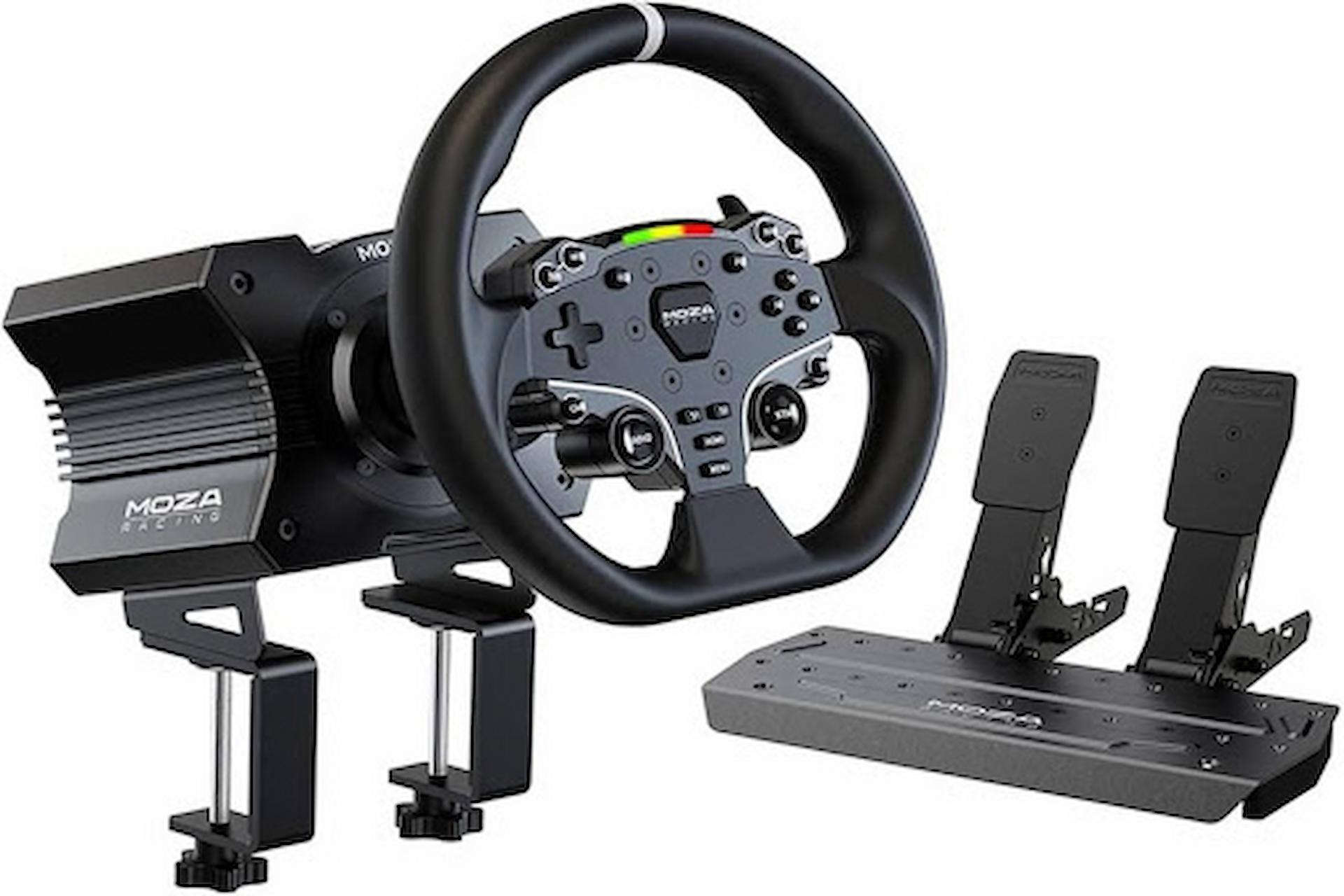
A sim racing setup isn’t just gear—it’s the difference between fighting the car and feeling completely in sync with it. Wheel torque, pedal resistance, seating angle, and screen placement all shape braking precision, corner stability, and lap consistency in ways most drivers underestimate. The right configuration transforms raw inputs into razor-sharp feedback and measurable performance gains. Here’s how every adjustment on your rig can redefine control, immersion, and speed on track.
Sim racing rewards precision. Small changes in hardware setup can deliver noticeable improvements in lap times, consistency, and driver confidence. The right configuration reduces mistakes, improves control, and makes performance repeatable rather than accidental. For many drivers, upgrading or correctly tuning a setup—such as the Moza R5 bundle—is not about luxury. It is about performance efficiency.
This article breaks down how sim racing setups influence results, from wheel feedback and pedal control to seating position and system stability. Each section focuses on performance impact rather than brand promotion, helping drivers understand why setup quality matters.
Why Setup Quality Directly Impacts Driving Results
A sim racing setup forms the physical link between the driver and the simulation. If that link is inconsistent or poorly configured, performance suffers regardless of skill level.
A well-balanced setup improves:
- Steering accuracy
- Braking consistency
- Throttle control
- Driver endurance
- Feedback interpretation
Poor setups, by contrast, introduce input delay, vague feedback, and physical strain. Over a race distance, these issues compound into slower lap times and more errors.
Steering Wheels: Feedback, Torque, and Control
The steering wheel is the primary communication channel between the simulation and the driver. Its purpose is not just to rotate the car, but to convey detailed information about grip, weight transfer, and road surface changes. The clarity and balance of this feedback strongly influence steering accuracy, reaction timing, and overall control.
Well-defined force feedback allows drivers to sense understeer and oversteer earlier, choose more accurate corner entry speeds, and minimise mid-corner corrections. Direct drive systems, when correctly tuned, deliver cleaner and less filtered signals, which strengthens muscle memory and improves steering discipline. However, higher torque alone does not lead to better performance. Excessive force increases fatigue and can slow reactions, while balanced torque preserves detail, enables smooth countersteering, and supports consistent driving over longer sessions.
Pedals: Where Lap Time Is Won or Lost
Pedals have a greater impact on lap times than most drivers realise. Braking accuracy, throttle modulation, and consistency across laps all depend on pedal quality and configuration. A strong pedal setup enables repeatable performance rather than occasional fast laps.
Why Brake Feel Is Critical
Braking consistency has a stronger impact on lap times than outright speed. Pedals that provide progressive resistance allow precise modulation rather than on–off inputs.
Performance benefits of well-set pedals include:
- Stable trail braking
- Reduced lockups
- Consistent braking points
Load-based braking encourages pressure control instead of travel distance, improving repeatability across laps.
Throttle Control and Corner Exit
Smooth throttle application determines exit speed. Pedals with predictable resistance help drivers avoid wheelspin and maintain traction through acceleration zones.
Rig Stability: The Hidden Performance Factor
Rig stability is often overlooked, yet it underpins every other component. Flex or movement in the rig absorbs driver input and distorts feedback. Even small amounts of instability can undermine confidence during heavy braking or fast transitions.
Eliminating Flex and Movement
Rig flex absorbs input energy. When a brake pedal or wheel mount moves, feedback accuracy drops.
Stable rigs provide:
- Direct translation of inputs
- Consistent muscle memory
- Better immersion and focus
Even small amounts of movement can undermine confidence during heavy braking or fast direction changes.
Why Stability Reduces Errors
When hardware behaves predictably, the brain focuses on racing decisions instead of compensating for inconsistencies. This reduces mental load and improves racecraft.
Seating Position and Ergonomics
Seating position and ergonomics strongly influence performance and endurance. Poor alignment increases fatigue, limits precision, and raises error rates during longer sessions. Correct positioning allows natural movement, supporting smoother inputs and consistent control.
Driver posture affects reaction time and stamina. A proper setup maintains neutral wrist angles, provides firm lower-back support, and keeps the knees slightly bent at full pedal travel. Wheel and pedal alignment improve steering and braking accuracy, while balanced ergonomics reduce unnecessary movement and help maintain precision throughout a race.
Monitor Position and Visual Feedback
Visual information guides every decision on track. Monitor placement affects depth perception, speed judgement, and braking accuracy. Incorrect positioning distorts visual cues and increases reaction time.
Field of View Accuracy
Visual information guides braking points, apexes, and exits. Incorrect screen distance or height distorts speed perception.
Optimised displays improve:
- Depth judgement
- Peripheral awareness
- Corner approach accuracy
Screen Stability Matters
Monitor movement introduces visual noise. A fixed display maintains reference consistency, supporting smoother driving inputs.
Software Settings That Support Hardware Performance
Even high-quality hardware underperforms if software settings are incorrect. Calibration and tuning ensure that physical inputs align accurately with in-game responses, maximising the benefit of the setup.
Force Feedback Tuning
Hardware quality only matters if software settings are correct. Over-filtering masks detail, while under-filtering introduces noise.
Recommended tuning priorities:
- Maintain road feel clarity
- Avoid clipping during heavy loads
- Preserve small steering cues
Calibration Is Non-Negotiable
Uncalibrated pedals and wheels undermine consistency. Calibration ensures full input range is recognised accurately, aligning physical effort with in-game response.
Performance Scaling With Equipment Quality
Performance improvements scale with balance rather than cost. A well-matched setup delivers better results than mismatched premium components. Integrated systems often provide smoother learning curves and more predictable behaviour.
This is why performance-oriented drivers often consider setups like the Moza R5 bundle as a foundation for controlled progression rather than rapid over-upgrading.
Entry-Level vs Balanced Systems
Performance gains come from balance, not extremes. A well-matched system improves results more than mismatched high-end components.
Mid-range systems—when correctly configured—offer:
- Predictable feedback
- Stable control
- Reduced learning curve
This is why integrated setups like the Moza R5 bundle are often chosen for performance-focused builds rather than purely visual upgrades.
Actionable Setup Tips for Better Results
Applying setup principles methodically delivers immediate performance gains, even without new hardware. Small adjustments often unlock hidden potential.
- Prioritise braking feel
Consistent braking delivers the biggest lap time gains. - Reduce unnecessary force
Aim for clarity, not strength, in wheel feedback. - Eliminate movement
Secure wheel mounts, pedals, and monitors firmly. - Optimise ergonomics first
Comfort and alignment improve endurance and accuracy. - Tune before upgrading
Proper calibration often unlocks hidden performance.
How Setup Quality Affects Skill Development
A reliable setup accelerates learning. When inputs behave consistently, drivers identify mistakes clearly and correct them faster.
Benefits include:
- Faster improvement curves
- Stronger muscle memory
- Better confidence under pressure
Inconsistent setups blur cause and effect, slowing progress and reinforcing bad habits.
Long-Term Performance and Upgrade Strategy
Long-term performance depends on a clear and logical upgrade strategy rather than chasing trends. Addressing fundamentals such as rig stability, pedal quality, and ergonomics delivers greater gains than isolated or cosmetic changes. These elements form the foundation of consistent control and reliable performance.
When upgrades follow performance logic, wheel feedback clarity and visual alignment build on a stable base rather than compensating for weaknesses elsewhere. Upgrading without first correcting core issues often leads to diminishing returns. Over time, a balanced and well-integrated system consistently outperforms piecemeal improvements.
Closing Remarks
Sim racing performance is shaped as much by setup quality as by driving skill. Every component—from pedals to seating—affects control, consistency, and confidence. A thoughtfully configured system reduces errors and supports long-term improvement. When chosen and tuned correctly, setups such as the Moza R5 bundle demonstrate how balanced hardware can translate effort into measurable results.